
Read Clearwater County Property Tax Records by Custodian
Two offices divide the work in Clearwater County. The Assessor appraises each parcel. It also maintains the owner, acreage, class, and exemption fields behind your tax bill. The Treasurer then issues the bill, records payments, and manages anything past due. County GIS adds public parcel and value clues. Its cards are not copies of the tax bill itself. Knowing the custodian saves you a phone call.
| Field | What It Shows | Where |
|---|---|---|
| Assess_Val and Market_Val | Parcel assessment and market-value fields | Assessor and GIS |
| Land, improvement, total values | Work-value components | Assessor and Parcels layer |
| Exemption or reduction | Relief affecting taxable value | Assessor |
| Bill and payment status | Amount billed, paid, or delinquent | Treasurer |
| Tax code area | Clue to districts tied to the parcel | GIS and county records |
Five numbers get confused constantly. Assessed value, market value, taxable value after relief, sale consideration, and the final bill each mean something different, so compare them only for the same parcel in the same year.
The Clearwater Assessor Card Starts the Value Check
The ParcelOwnership GIS layer can carry Owner1, mailing and situs addresses, Assess_Val, Market_Val, acreage, class, tax code, rvyear, last-sale fields, and deed references. A base Parcels service adds WorkValue_Land, WorkValue_Impv, and WorkValue_Total. Keep the parcel ID and value year beside every figure, since Clearwater publishes no guaranteed refresh interval between closing and roll. When GIS leaves gaps, the official Assessor page handles value, owner, acreage, and exemption questions. That county page is the authoritative route for anything the map cannot settle.
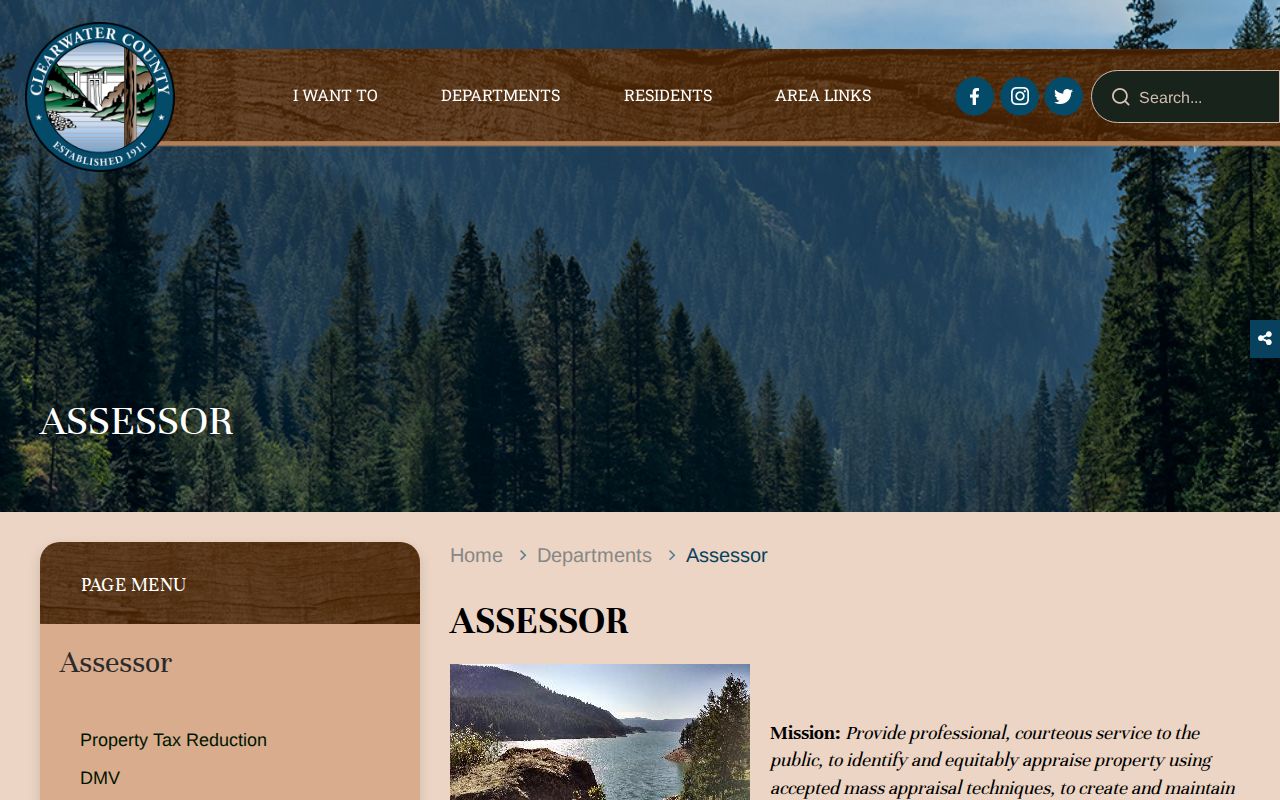
It does not establish a stand-alone public owner or address search form.
Clearwater Taxable Value Is Not a Recorded Sale
Taxable value bends with relief. An exemption can shrink what you owe. It leaves the full assessment and the market-value field untouched. A deed sale can land at a different figure too. It may have closed on another date or under unusual terms. So pull the transfer from the Recorder's recorded instrument. And pull tax valuation from the Assessor's data for that exact year.
Assessed value is the tax-system value; market value is the appraisal framework's estimate. Taxable value reflects relief applied, and a tax lien is a claim tied to unpaid tax.
Look Up a Clearwater County Tax Bill Through the Treasurer
The Access Idaho page handles payments, not deed research. It publishes no public tax-bill document index. Identify the parcel in GIS first, then confirm the bill and its status through the Treasurer's official channels. That habit keeps a payment screen from being mistaken for an owner, assessment, or bill-history search.
- Find and copy the parcel number from Clearwater County GIS.
- Open the Treasurer payment page or contact the office with that number.
- Confirm tax year, amount, payment status, and any delinquency.
- Send value, owner, exemption, or acreage errors to the Assessor.
- Levy
- The taxing-district rates applied in the tax process.
- Homeowner exemption
- Qualifying relief that reduces taxable impact.
- Payment status
- The Treasurer's record of what is due or paid.
- Tax lien
- A legal claim arising from unpaid tax.
Pay Clearwater Property Tax Online, by Mail, or Drop Box
The Treasurer offers Access Idaho, mail, and drop-box payment methods. Taxpayers should include the parcel number with any payment. Mail goes to PO Box 707. Card payments carry a 2.50 percent processing charge, so confirm current instructions before you pay.
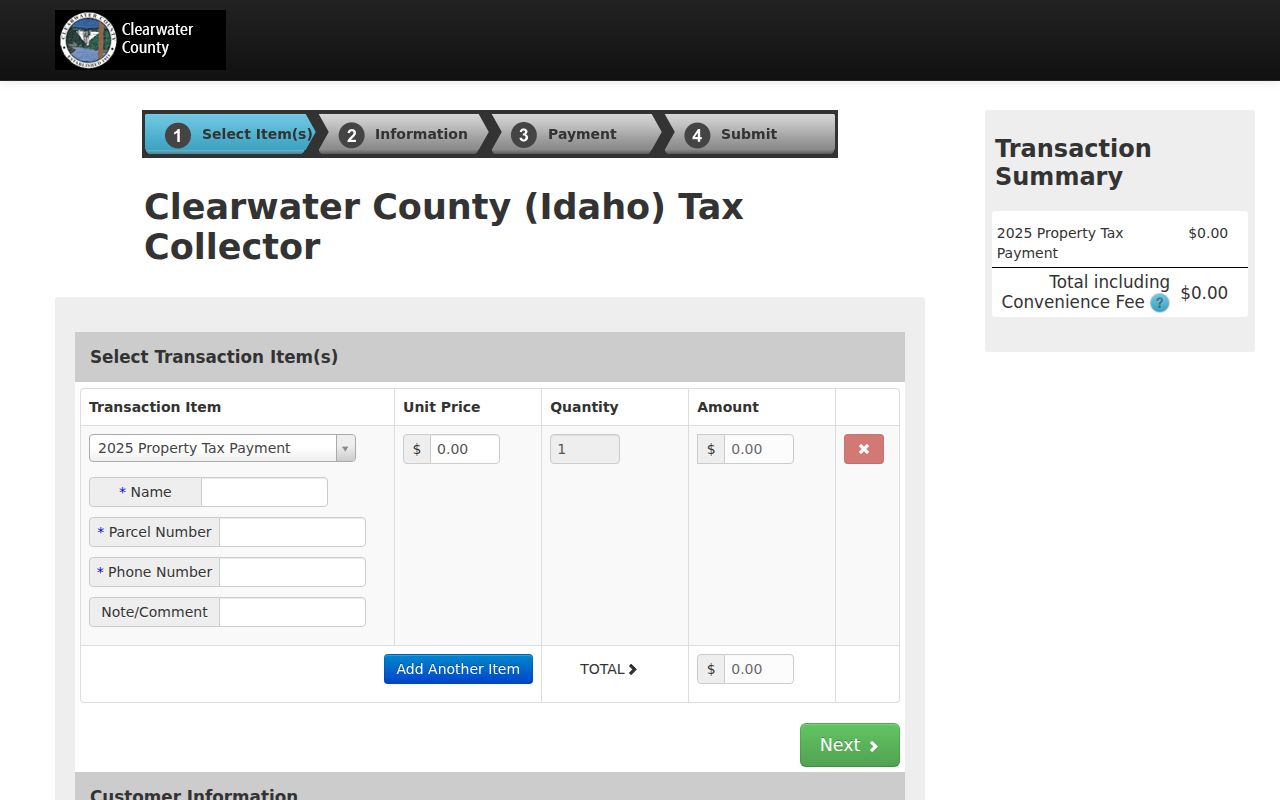
The office takes Clearwater County property tax payments online, by mail, and at a drop box. Pick the route that suits you.
Clearwater Homeowner Relief Has Separate Programs
Idaho's homeowner exemption covers 50 percent of a qualifying home's value. It applies up to $125,000 and up to one acre, subject to current rules and an accepted application. Property Tax Reduction is a separate annual program with its own income test. For 2026, Clearwater's page listed a $37,810 prior-year income limit after medical expenses. The state's current page showed $39,130. Trust the current state rule and confirm with the Assessor. The Assessor's forms index also carries agricultural, forest-management, and timber materials for qualifying land.
The 2026 Clearwater Reduction Cycle Was Date-Specific
The 2026 cycle drew on 2025 income and an April 15 deadline. It also used medical-expense records plus federal-return or SSA-1099 material. A state online filing route was available. Clearwater announced March outreach sessions in Weippe, Pierce, and Elk River. An April 7, 2026 state release described a benefit of up to $1,500. Recheck every detail for the active year before filing.
Delinquent Clearwater Tax Records Follow a Three-Year Path
Delinquency does not transfer ownership right away. The Treasurer describes a three-year real-property tax-deed process, with notice, four-week publication, and a redemption window before any deed issues. Confirm the parcel, the years involved, notice and redemption status, and any final recorded deed.
Appeal a Clearwater County Assessment on the Idaho Calendar
Start with the assessment notice and compare it against the parcel fields. Factual errors go to the Assessor first. The filing deadline is the fourth Monday in June on Idaho's calendar. The Board of Equalization convenes July 1. Official weekend and holiday rules apply. File with the county clerk and bring parcel-specific market evidence. Payment problems still route to the Treasurer, not the appeal path. For longer history, the 2025 county financial statement reports countywide assessed-market-value totals for 2019 through 2023. It explains the November levy and December-June payment cycle. It is not a parcel bill or a city trend report. Older tax rolls may need a county or Idaho State Archives request.
Appeal window. Confirm the current notice and fourth-Monday-in-June filing date with the county clerk before the deadline.
Build an appeal around one parcel, one year. Gather the notice, the identifiers, and the legal description. Add acreage, class, land and improvement components, value fields, rvyear, and exemption status. Evidence should back the correction you request. Keep a deed sale distinct from an appraisal opinion, and explain any difference in dates.
Not every mismatch belongs in an appeal. A payment the county did not credit belongs with the Treasurer and its receipt. Name, acreage, class, or exemption questions go to the Assessor. A legal transfer goes to the Recorder. Routing each issue first keeps the short appeal window free for a genuine value dispute.
Old tax research starts with the years. Ask whether the county or Idaho State Archives holds the roll for those years. The payment interface does not prove a complete bill archive. Countywide totals cannot establish a parcel or city trend without supporting records.
Keep the parcel year visible when comparing records. Treat rvyear as context, not a published guarantee of an exact refresh date. LastSellDa and LastSellVa may be blank or zero. Deed1 through Deed5 point toward instruments. The Treasurer confirms whether a bill was paid. So a sound conclusion names the field and custodian that support it.
A tax-deed inquiry should cross three custodians. The Treasurer supplies the delinquency and redemption process. The clerk or court file may hold related proceedings, and the Recorder supplies the deed that finally changes the recorded land trail. Publication for four weeks is one stage of the county process, not proof that a deed issued, so ask for dates and status instead of inferring an outcome from an old notice.
County financial statements offer broad context only. Their 2019 through 2023 assessed-market-value totals cannot prove what happened to one home, one city, or one class of land. Parcel-level comparison needs the same identifier. It needs the same valuation component too. A stated year belongs with each record.