
Clearwater County Deed Records by Instrument Type
Deed records in Clearwater County cover more instruments than deeds alone. The Auditor/Clerk/Recorder accepts mortgages, deeds of trust, liens, releases, and reconveyances. Each records a different interest or a later change in the land's status. Begin with the instrument type and the parties. Then match the result to the parcel or legal description. The county publishes no public grantor-grantee search screen online. The Recorder counter, phone requests, and written requests carry the workload.
| Deed Type | What It Does | Common Use |
|---|---|---|
| Warranty deed | Conveys the stated interest with deed covenants | Conventional transfer |
| Quitclaim deed | Conveys whatever interest the grantor holds | Interest cleanup or family transfer |
| Trustee or representative deed | Conveys through a trustee or authorized estate actor | Trust, estate, or court-linked transfer |
| Correction deed | Corrects a defect or description in an earlier instrument | Name or land-description repair |
| Tax or sheriff deed | Records a transfer after the governing legal process | Delinquency or judicial sale trail |
Never stop at a deed list when the question is clear ownership. Mortgages, liens, releases, reconveyances, plats, easements, and court-linked notices can all touch the same land trail.
What Clearwater's Recorder Publishes Online
The official Recorder landing page provides the office route, contact navigation, and a fee link for Clearwater County. It displays no county-hosted deed index and states no official online coverage year. The ArcGIS deed-reference fields are not the index. To reach recorded instruments, visit 150 Michigan Avenue, Room 201, Orofino, call 208-476-5615, write to PO Box 586, or inspect records at the counter. The county page itself shows the access route a visitor will use.
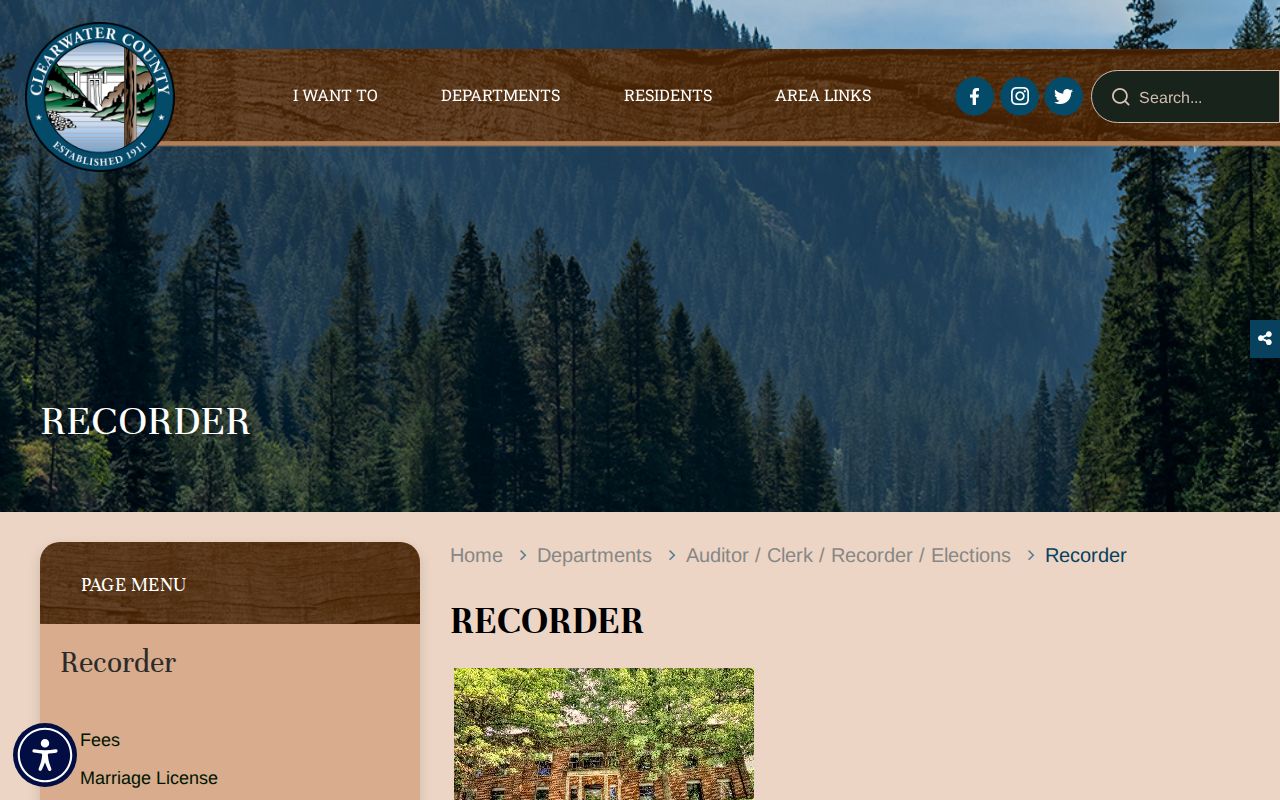
The county's Recorder page displays the office and fee navigation a requester needs before contacting staff.
Start Clearwater Deed Records With GIS References
The ParcelOwnership layer can display Deed1 through Deed5, Deed_Date, LastSellDa, and LastSellVa beside the parcel and owner fields. Treat each field as a finding aid. A blank does not prove that no deed exists. A displayed sale value can be zero or incomplete. Copy the exact deed reference, current parcel ID, legal description, owner string, and date clue, then request the actual recorded instrument from the Recorder.
Trace Clearwater County Deeds Through Both Names
A grantor-grantee index runs in two directions. Find the deed through the person or entity giving the interest and the one receiving it, then confirm the legal description matches the same land. Clearwater County's records reach back through deed books rather than a single public online form, so this method may involve Recorder staff and physical volumes.
- Use GIS and the assessment owner as a lead to the newest likely grantee.
- Request that name in both grantor and grantee directions with an approximate date.
- Read the returned instrument's legal description and prior grantor.
- Repeat with the prior grantor as a grantee, moving backward one conveyance at a time.
- For older gaps, ask which deed book, index, archive, or predecessor county holds the next link.
- Grantor
- The party conveying the stated interest.
- Grantee
- The party receiving that interest.
- Chain of title
- The linked sequence of instruments affecting the land.
- Book/page or instrument reference
- The locator needed to retrieve a recorded document.
Pre-1911 Clearwater Land May Sit Under Another Jurisdiction
Clearwater County was created on February 27, 1911. Before that, the region's record story runs through Pierce and Oro Fino mining, homesteading, Orofino's 1898 townsite plat, and the 1899 railroad era. Pierce had a courthouse in 1862. The Shoshone County seat moved to Murray after 1885. Those dates are custody clues, not proof of a courthouse fire or lost records. Search historical names and predecessor jurisdictions, then prove continuity through the legal description. Test both "Oro Fino" and "Orofino" without assuming the older mining settlement and the later townsite share one parcel history.
Plats and Legal Descriptions Control the Clearwater Match
A street name can change while the land description persists. In a platted area, save subdivision, lot, block, plat amendment, vacation, and dedication terms. Rural parcels need township, range, section, metes-and-bounds calls, and acreage preserved intact. The GIS Subdivisions layer is a lead to a recorded plat. It is not the complete plat text. Exact labels matter. Include spelling variants found in the map.
Liens, Releases, and Court Files Beside the Deed Trail
A deed chain answers who conveyed an interest. It does not by itself resolve deeds of trust, mortgages, liens, releases, reconveyances, lis pendens, foreclosure, quiet-title, partition, or probate issues. Search the Recorder for recorded instruments. Search the Idaho iCourt Odyssey portal for a case lead. The Clearwater Clerk counter or kiosk is the route to complete county case files, and any resulting deed or release should be matched back to the Recorder record.
Order a Clearwater County Deed Copy With a Precise Request
Give the Recorder the names in both roles. Include the approximate recording or transfer date, parcel identifiers, and the legal description. Add subdivision or PLSS terms, and any Deed1 through Deed5 reference. State whether a plain copy or a certified copy is needed. The county links a recording-fee PDF dated 2018. Confirm the current charge and delivery method rather than treating that sheet as a permanent price list.
For older material, the Idaho State Archives offers catalog and research-request routes. FamilySearch catalog results are leads whose exact item, image access, and custody must be verified. Newspaper and probate clues can help find an heir or event. The recorded transfer remains the ownership evidence.
Recorded, not guaranteed. Clearwater County deed records show accepted instruments, not an insured title opinion; unrecorded interests and unresolved defects may exist.
Precision earns results at the Clearwater County Recorder. List each party spelling you know, including initials and suffixes for trusts, estates, or entities. Then anchor the request to the land itself. Give a date range plus a parcel ID, subdivision lot and block, or township-range-section language and metes-and-bounds wording. A GIS map may show several deed references. Ask the staff which locator pulls the actual instrument. Do not assume the display runs in chronological order.
Check what comes back against the prior link in the chain. Match the parties, dates, legal description, exceptions, and recording reference. A probate file, a correction, a plat amendment, a release, or a court case can sit behind a gap. A conveyance-only list may hide that gap. Label your sources honestly. A catalog result is a lead. A newspaper notice is context. A GIS field is only a map attribute. The Recorder's accepted instrument remains the recorded source that counts.
The fee sheet linked from the Recorder's navigation carries a July 1, 2018 date. That is provenance, not a promise that every charge still stands. State whether your copy must be certified. Ask for the current fee and delivery method. Keep the receipt with the instrument reference.
Subdivision names can rescue a stalled Clearwater County deed search. But they only help when they stay tied to the land. The county Subdivisions service supplies mapped labels and geometry rather than the full recorded plat. Request the plat itself. Request amendments, vacations, street dedications, and easements too. Give the exact label and parcel. In Pierce, run both the GIS spelling STOVER'S ADDTION and the corrected "Stover's Addition." In Orofino, keep the 1898 townsite apart from the earlier Oro Fino mining settlement unless the deed records themselves connect the legal descriptions.
Your property records search can extend to the Idaho State Archives. Use catalog fields like place, record type, keyword, and year. Write down the catalog identifier. Before citing contents, confirm where the item sits. It may sit at the archive or the county courthouse. It may sit on microfilm or in a digital collection.